



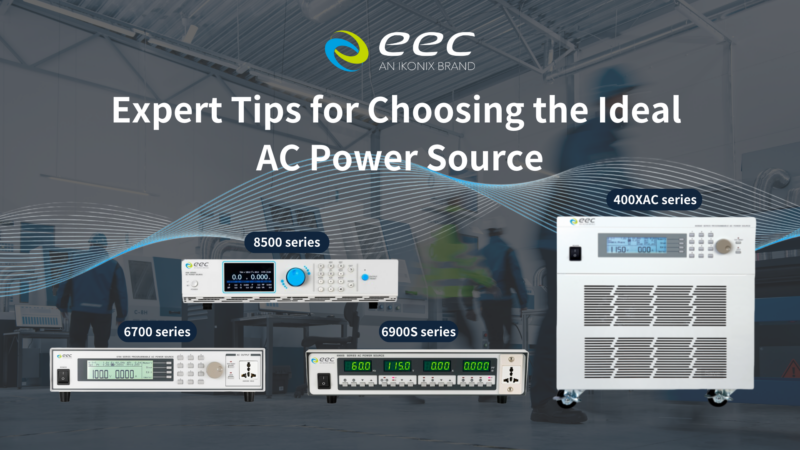
Knowing how to choose an AC power source means looking beyond basic power output. Power rating and configuration set the baseline, but crest factor, inrush current, safety protections, and application-specific requirements (like IEC 61000 or leakage current testing) determine whether a power source will actually perform reliably under real test conditions.
If medical equipment or industrial machinery fails due to abnormal or disrupted power during operation, the consequences can be serious. That’s why AC power sources are indispensable during testing — they simulate real-world power scenarios to evaluate a device’s performance, quality, and reliability. On the production line, they also provide precise control over voltage and current, avoiding the instability of raw utility power.
With so many options on the market, how to choose an AC power source comes down to evaluating three areas: power output capability, additional performance factors like crest factor and inrush current, and application-specific requirements.
Power Output Capability and Configuration
The first step in how to choose an AC power source is determining the required power output capability and configuration. The power output capability, also known as the power rating, varies widely depending on the application. As a general rule of thumb:
| Power Rating | Typical Application |
|---|---|
| 500VA – 1000VA | Small electronic devices |
| 1000VA – 3000VA | Larger consumer electronics, industrial components |
| 3000VA – 6000VA | Heavy industrial machinery, high-power electronics testing |
To ensure optimal performance and avoid overloading, it’s essential to choose a power source with a rating that matches or exceeds your total power requirement.
Similarly, power configuration options include single-phase (1Ø) and three-phase (3Ø). Usually, small home appliances require a single-phase AC source, while a three-phase AC source is ideal for heavy industrial equipment or larger commercial installations.
The EEC AC Power Source offers a versatile range of power output capabilities from 500VA to 6kVA and configurations including single-phase (1Ø) and three-phase (3Ø). This versatility ensures that different application needs are met, providing your devices with consistent and reliable power.
Additional Factors in How to Choose an AC Power Source
Beyond power output capability and configuration, several other key factors matter when working out how to choose an AC power source for your specific application:
1. Crest Factor and Inrush Current
The significance of crest factor and inrush current lies in applications that necessitate high inrush current, such as motor starting or capacitor charging. If an AC power source fails to effectively manage these high peaks, it could result in damage. Considering inrush current and crest factor also helps avoid procuring a larger capacity than actually needed just to cover occasional spike demands.
Inrush current refers to the maximum instantaneous input current drawn by an electrical device when it is switched on, often exceeding its normal operating current. Crest factor, which compares the peak value to the RMS (root mean square) value of a waveform, is crucial for evaluating a power source’s ability to manage sudden spikes in current. For example, heating elements typically have crest factors ranging from 1.4 to 1.6, while power supplies in computers and electronics often have crest factors between 2.0 and 3.0.
To accommodate the initial inrush current, the EEC AC Power Source offers an inrush current capacity of 4x rated current. This ensures the power source can handle initial surges without compromising performance or safety. Additionally, the EEC power source boasts a specified crest factor of ≥3, indicating its capability to manage peak currents up to three times its rated current for short durations. For instance, if the power source has a maximum current of 20A at 100VAC, it can sustain peak currents up to 3×20A = 60A.
2. Safety Features
AC power sources output high voltage and current, posing potential hazards to operators. This is a critical part of how to choose an AC power source safely — the EEC AC power source integrates several essential safety features: Over Current Protection (OCP), Over Temperature Protection (OTP), Over Power Protection (OPP), Over Voltage Protection (OVP), and Short Circuit Protection. In case of abnormal status, indicators illuminate to alert operators, and output voltage is immediately cut off. These safety measures ensure prompt response and mitigate risks, shielding both users and equipment from harm.
3. Specific Application
As mentioned previously, the AC power source plays an important role in simulating abnormal power conditions, which is required in IEC 61000 testing. This includes simulating common grid faults, voltage dips, and other power irregularities. To fulfill these requirements, the AC source should provide flexibility in configuring different waveforms or incorporate built-in waveforms. This guarantees accurate testing and replication of real-world conditions.
The AC source is also crucial for electrical safety testing. For example, the IEC 60601 leakage current test is significant for testing medical devices, requiring stable and precise power delivery. Typically, manufacturers pair the EEC AC source with an Associated Research electrical safety tester. Ensuring compatibility between the AC source and the safety tester is an essential final step in how to choose an AC power source for medical device applications.
Choosing the Right EEC AC Power Source Series
The right AC power source goes beyond just matching Power Output Capability and Configuration. Considering factors like crest factor and inrush current, safety feature and application is also important to ensures your power source delivers reliable, efficient, and safe power to your devices. Whether it’s for small home appliances or critical industrial systems, the right power source can significantly impact performance and quality. EEC provide different series of AC power source for your different need.
EEC 8500 Series
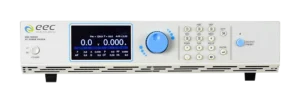
EEC 8500 Series offers a broad range of power ratings from 500VA to 6kVA, features a crest factor of ≥3, and supports inrush currents up to four times the rated current. Additionally, it enables the simulation of IEC 61000 common grid faults, voltage dips, and other power abnormalities, ensuring product quality and reliability. With an output voltage of up to 310VAC and a frequency range from 5 Hz to 1,200 Hz, it caters to a wide range of applications.
EEC 400XAC Series
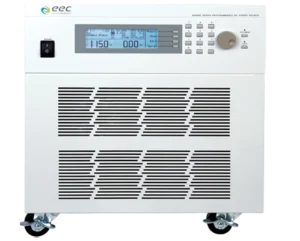
The EEC 400XAC Series provide power ratings of 3kVA and 6kVA, offering both single-phase (1Ø) and three-phase (3Ø) power in a single-box solution. If you need an AC power source with superior application flexibility, look no further than the EEC 400XAC. Our exclusive SmartCONFIG feature allows the 400XAC Series to seamlessly switch from single-phase to three-phase power with the push of a button, ensuring optimal performance for a wide range of applications.
EEC 6700 Series
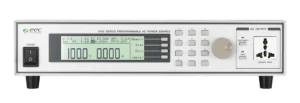
Linear Programmable AC Power Source provides clean power across a range from 500VA to 5kVA, making it ideal for networking communication, audio and video equipment, and surveillance systems due to its ultra-low noise design. With high-load capacity capabilities—crest factor greater than 3, inrush current greater than 4, and Over Current Fold (OCF) functionality—it ensures maintaining current for devices requiring high inrush current activation. Additionally, it features comprehensive safety protections for over-current, over-voltage, over-power, over-temperature, and short circuits, optimizing both the power source and operator safety.
EEC 6900S Series
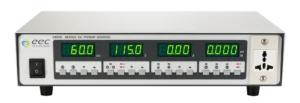
Provides a wide range of power selection options from 500VA to 5kVA for every test scenario, including home electronic appliances, power adapters, LEDs, and even laboratory testing. It simulates worldwide AC power conditions with a wide and flexible combination of adjustments for output voltage ranges of 0-310V and a frequency range of 40-450Hz.
FAQ
How do I choose the right power rating for an AC power source?
Match the source’s power rating to or above your device’s total power requirement — 500–1000VA for small electronics, 1000–3000VA for medium-scale applications, and 3000–6000VA for heavy industrial use.
Why does crest factor matter when choosing an AC power source?
Crest factor indicates how well a power source manages sudden current spikes relative to its steady-state (RMS) output — important for devices with high inrush demands like motors or capacitors.
What safety features should an AC power source include?
Look for Over Current, Over Temperature, Over Power, Over Voltage, and Short Circuit Protection, which should immediately cut output and alert operators during abnormal conditions.
Can an AC power source be used for IEC 60601 leakage current testing?
Yes — pairing a compatible AC power source (such as the EEC 8500 Series) with an electrical safety tester like the OMNIA® II supports IEC 60601 leakage current testing for medical devices.

