



IEC 60335-1 is the base safety standard for household and similar electrical appliances, covering everything from kitchen appliances to power tools. It sets the general electrical, mechanical, and thermal safety requirements that every appliance in its scope has to meet, and it’s almost always used alongside a Part 2 standard specific to the product type. This guide covers what IEC 60335-1 requires, the electrical safety tests it calls for, and how they fit together as a test sequence.
What Is IEC 60335-1?
IEC 60335-1 is Part 1 of an international standard covering the general safety requirements for household and similar electrical appliances. It applies to appliances rated up to 250V for single-phase devices and up to 480V for multi-phase devices, and it covers electrical safety, mechanical safety, thermal safety, and other hazards like radiation and chemical exposure.
Part 1 sets the baseline requirements, but it’s almost never used alone. Each appliance category, kitchen appliances, floor care, personal care, heating appliances, and so on, has its own Part 2 standard that modifies or adds to what Part 1 requires. A hair dryer and a space heater are both tested against IEC 60335-1, but each is also tested against its own Part 2 standard covering requirements specific to that product type.
Appliance Classes: Why They Matter for Testing
IEC 60335-1 groups appliances into classes based on how they protect against electric shock, and the test requirements differ by class:
- Class I appliances rely on basic insulation plus a connection to protective earth. If the basic insulation fails, the earth connection is the backup.
- Class II appliances rely on double or reinforced insulation instead of an earth connection, which is why double-insulated tools don’t have a three-prong plug.
- Class III appliances operate on safety extra-low voltage, low enough that dangerous shock isn’t possible under normal conditions.
Because the shock protection method is different for each class, the specific pass/fail values for insulation resistance, dielectric strength, and leakage current tests differ by class too.
What Electrical Safety Tests Does IEC 60335-1 Require?
IEC 60335-1 calls for several electrical safety tests as part of demonstrating compliance. These typically run in sequence rather than independently:
Ground continuity (Class I appliances only). Before any other electrical test, the connection between the appliance’s earth pin and its exposed metal parts is verified, confirming there’s a low-resistance path to ground in place.
Insulation resistance test. Resistance is measured between live parts and accessible surfaces, with the minimum acceptable value depending on the insulation type and appliance class.
Dielectric strength (hipot) test. A high voltage is applied between live parts and accessible surfaces for a specified duration, typically one minute, to confirm the insulation doesn’t break down under stress beyond normal operating levels.
Leakage current test. Current is measured under normal and single-fault conditions, confirming it stays below the safe threshold for someone touching the appliance, with the allowable limit varying by appliance class.
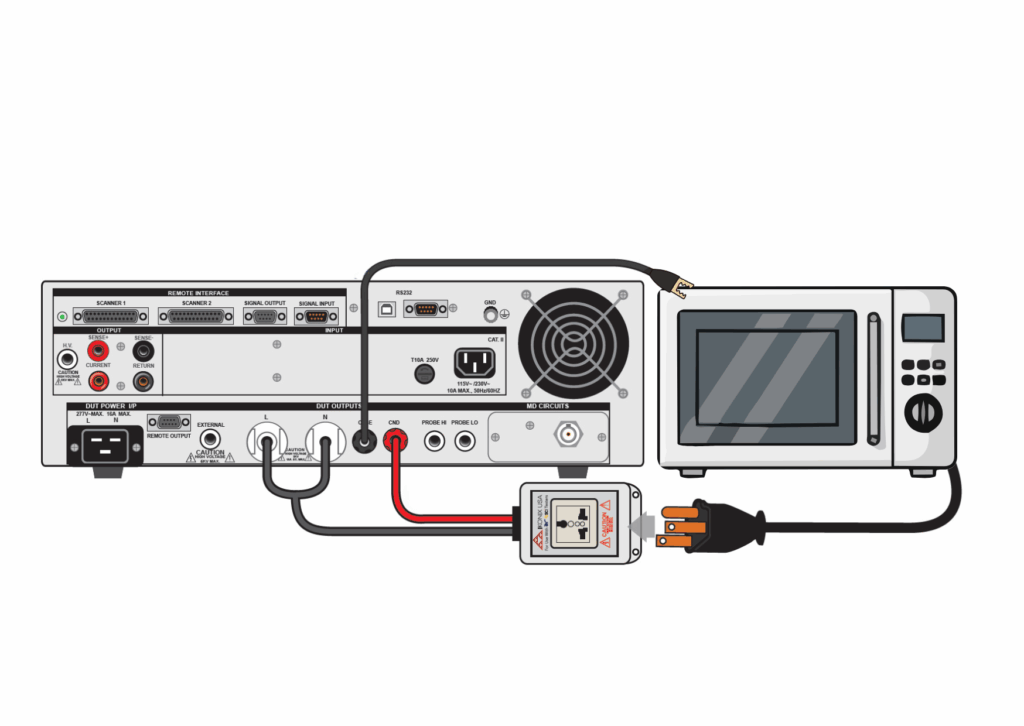
Passing the dielectric strength test doesn’t guarantee a passing leakage current reading, since the two tests catch different kinds of insulation problems. That’s part of why manufacturers typically run all four as a sequence rather than treating any one as sufficient on its own.
Compliance Beyond Electrical Safety Testing
IEC 60335-1 is typically required for CE marking under the EU Low Voltage Directive, UKCA marking, and similar market access requirements in other regions. Most appliances also need EMC testing alongside IEC 60335-1, covering emissions and harmonic current, which is outside the scope of this guide but worth being aware of as part of the full compliance picture.
Choosing Equipment for IEC 60335-1 Testing
Since IEC 60335-1 testing typically involves ground continuity, insulation resistance, dielectric strength, and leakage current in sequence, an instrument that combines all four in one platform keeps the test station simple and avoids re-fixturing the DUT between tests.
FAQ
What is IEC 60335-1? IEC 60335-1 is the general safety standard for household and similar electrical appliances, covering electrical, mechanical, and thermal safety. It’s used alongside a product-specific Part 2 standard for each appliance category.
What electrical tests does IEC 60335-1 require? Ground continuity for Class I appliances, an insulation resistance test, a dielectric strength (hipot) test, and a leakage current test, typically run in that order as part of the same test sequence.
What’s the difference between Class I, II, and III appliances under IEC 60335-1? Class I appliances use basic insulation plus a protective earth connection as a backup. Class II appliances use double or reinforced insulation instead of an earth connection. Class III appliances operate at a low enough voltage that dangerous shock isn’t possible under normal conditions.
Does passing the dielectric strength test mean an appliance passes the leakage current test too? No. The two tests catch different failure modes, so a passing dielectric strength result doesn’t guarantee a passing leakage current reading. Both are typically required.

