




Medical device electrical safety testing verifies that devices meet IEC 60601, the international safety standard for medical electrical equipment, before they reach patients and healthcare professionals. Manufacturers commonly struggle with slow test cycles, operator error, and data traceability — this article defines the core required tests and outlines practical solutions for each challenge.
Medical devices come into direct contact with patients and clinicians every day. That trust depends on rigorous testing: if a device fails electrically, the consequences can include patient harm, equipment damage, and costly production delays. To prevent these outcomes, manufacturers must comply with IEC 60601, the global benchmark standard for medical electrical equipment safety.
What Is IEC 60601 and Why Does It Matter?
IEC 60601 is a series of international standards published by the International Electrotechnical Commission (IEC) that define safety and performance requirements for medical electrical equipment. Compliance is typically required before a device can be sold in regulated markets, making it a mandatory step — not an optional quality check — in medical device development.
Core Tests Required for Medical Device Electrical Safety Testing
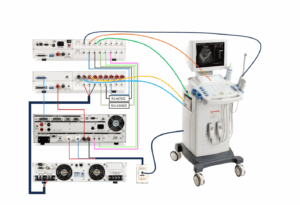
To meet IEC 60601 requirements, manufacturers must run several standardized tests:
| Test | Purpose |
|---|---|
| AC Hipot Test | Evaluates insulation strength for input power and applied parts |
| Ground Bond Test | Verifies grounding connections can safely handle fault currents (typically 25–40 amps) |
| Insulation Resistance Test | Confirms no unintended electrical current flows through insulation |
| Leakage Current Test | Measures unintended current flow in earth connections, applied parts, or between applied parts |
Each test targets a distinct failure mode, and most regulatory submissions require results from all four.
3 Common Challenges in Medical Device Electrical Safety Testing
1. Testing Takes Too Long
Challenge: Running multiple tests separately slows down production lines, especially at scale.
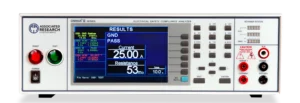
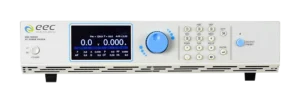
Solution: Consolidating tests into a single instrument — such as the OMNIA® II Series, which combines seven critical tests including withstand, insulation resistance, ground bond, and leakage current into one device — reduces per-unit test time. A built-in 500VA power source handles most devices; higher-power devices can use an external AC power source rated up to 6kVA for stable performance.
2. Operator Errors
Challenge: When doing medical device electrical safety testing, complex setups and frequent connection changes increase the risk of mistakes during manual testing.
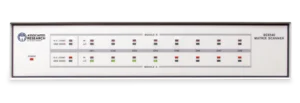
Solution: Multi-point scanning hardware simplifies batch testing by automating connection switching, reducing setup time and minimizing the chance of human error in high-volume testing environments.
3. Data Management and Traceability
Challenge: Manually logging pass/fail results, model numbers, and serial numbers for every unit is time-consuming and prone to gaps.
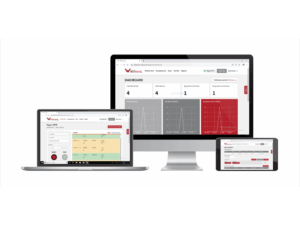
Solution: Automated test software that generates traceable digital reports — capturing pass/fail status and device identifiers automatically — simplifies documentation and supports audit readiness.
Key Takeaways
- Medical device electrical safety testing under IEC 60601 requires four core test types: hipot, ground bond, insulation resistance, and leakage current.
- Multi-test instruments reduce cycle time versus running each test on separate equipment.
- Automated scanning and reporting reduce operator error and improve traceability for regulatory audits.
FAQ
What is medical device electrical safety testing?
It’s the process of verifying a medical device meets electrical safety requirements under IEC 60601 before market release, covering insulation, grounding, and leakage current performance.
Why is IEC 60601 testing required?
Most regulated markets require IEC 60601 compliance evidence before authorizing sale of medical electrical equipment, to protect patients and clinicians from electrical hazards.
How can manufacturers speed up medical device testing?
Consolidating multiple required tests into a single multi-function instrument and automating batch testing reduces cycle time without skipping required checks.
Why use multiplexers for medical device electrical safety testing?
Multiplexers automate test-point switching across multiple leads or applied parts, removing the need for manual reconnection between test points — reducing setup time and preventing the poor-contact errors that can produce false pass or fail results during multi-point testing.

