



Electrical safety testing for manufacturers involves more than running a single hipot test — it requires balancing production speed, data traceability, and equipment reliability without compromising compliance. Based on decades of industry experience, this article outlines three recurring challenges manufacturers face and practical solutions for each.
Manufacturing performance depends on running smoothly while maintaining consistent quality standards. For companies performing electrical safety testing, this means solving three recurring problems: production efficiency, data visibility, and equipment reliability.
Achieving Efficiency in Electrical Safety Testing for Manufacturers
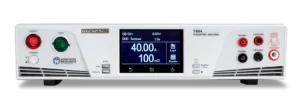
Manufacturers running fully automated, semi-automated, or manual production lines all face the same pressure: maximize testing speed without sacrificing accuracy. The HypotULTRA® and Hypot® series address this directly:
How It Helps Electrical Safety Testing for Manufacturers
| Feature | Benfits |
|---|---|
| Multi-test instruments | Combine hipot, insulation resistance, and ground bond testing in one device, reducing device switching |
| Barcode interface | Lets operators scan and run tests without a computer, reducing setup errors |
| Built-in memory | Stores up to 100,000 test results internally (more via external USB), preserving full production history |
| Multi-point testing | The HypotULTRA® with an optional 8-port scanner, or the SC6540 Multiplexer, automatically cycles through multiple test points after a single connection — critical for medical devices and batteries |
Beyond equipment, trained operators reduce both errors and safety risk during electrical safety testing for manufacturers. Application consulting on safety standards and best practices helps prevent injuries, fines, and litigation tied to high-voltage testing environments.
Real-Time Monitoring and Data Analysis for Quality Control
Analyzing test data as it’s generated — rather than after a production run — lets manufacturers catch quality issues before they scale into large defective batches. WithStand® software centralizes control of multiple instruments and auto-generates per-device reports, supporting faster, better-informed decisions. For manufacturers building custom testing systems, IVI and LabVIEW driver support enables integration with existing automation and quality control systems.
Regular Calibration and Maintenance for Stability and Compliance
Testing equipment accuracy degrades over time, and inconsistent calibration is a common — and costly — blind spot. Two issues come up repeatedly:
Calibration verification vs. accredited calibration
Verification only checks whether readings fall within an acceptable range; it does not correct drift. Accredited calibration adjusts the instrument to restore accuracy, directly reducing the risk of production failures.
Slow third-party turnaround
Sending equipment offsite for calibration can take weeks, and some labs calibrate only part of an instrument rather than its full function set.
As an ISO/IEC 17025-accredited calibration lab, full-scope calibration, verification, and adjustment can be completed with fast turnaround (e.g., five business days) — minimizing both downtime and compliance risk. Annual calibration programs that also extend equipment warranty add further long-term value.
Total Cost of Ownership: A Fourth Consideration
Electrical safety testing for manufacturers can be expensive. Equipment failures often strike right after a standard warranty expires, creating unplanned repair costs. Manufacturers can reduce total cost of ownership by combining:
- Extended manufacturer warranties (e.g. 5-year coverage)
- Annual calibration programs that add warranty years
- A flat-rate repair service with fast, predictable turnaround
Key Takeaways for Electrical Safety Testing for Manufacturers
- Electrical safety testing for manufacturers requires solving three linked problems: test speed, data visibility, and equipment stability.
- Multi-test instruments and barcode/multi-point automation directly cut testing time and operator error.
- Accredited calibration (not just verification) is essential to prevent measurement drift from causing compliance failures.
- Total cost of ownership — not just upfront equipment price — should factor into testing equipment decisions.
FAQ
What is electrical safety testing for manufacturers?
It’s the process of verifying that products meet required electrical safety standards during production, typically covering hipot, insulation resistance, and ground bond testing.
What’s the difference between calibration verification and accredited calibration?
Verification confirms whether an instrument’s readings fall within an acceptable range but makes no corrections. Accredited calibration actively adjusts the instrument to restore measurement accuracy per IEC-aligned standards.
How can manufacturers reduce total cost of ownership for test equipment?
Combining extended warranties, annual accredited calibration (which can add warranty years), and flat-rate repair services reduces unplanned repair costs over an instrument’s lifespan.
Why does multi-point testing matter for complex devices?
Multi-point testing lets operators connect leads once while the instrument automatically cycles through each test point, reducing setup time and connection errors — especially important for devices like medical equipment and batteries.

