




Cable and connector electrical safety testing verifies that the components linking servers, GPUs, and data centers can safely handle high voltage and fault current without failure. As AI infrastructure scales, hipot and ground bond testing — governed by standards like UL 444 and IEC 61984 — become essential to preventing shock hazards and maintaining system reliability.
Recent advancements in server power designs to enhance AI data processing efficiency have further underscored the need for rigorous cable and connector electrical safety testing. While our previous issue explored the electrical safety of servers, this issue focuses specifically on ensuring the safety and reliability of cables and connectors — key components in maintaining the integrity and performance of AI infrastructure.
Role of Cables and Connectors in AI Ecosystems
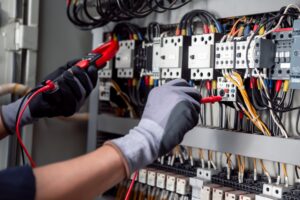
Data Transmission: AI applications, such as machine learning and real-time data processing, require high-speed data transfer and efficient handling of large data volumes. Cables are essential for linking servers, GPUs, and other data-intensive devices. High-quality connectors and cables help minimize data loss and signal degradation, ensuring the integrity of the data being processed.
Power Delivery: AI systems, particularly those involving deep learning models, demand substantial and reliable power for hardware components, including servers, GPUs, and other computational devices. Power cables and connectors can support high power loads while maintaining stable connections to prevent disruptions and ensure uninterrupted operation.
Scalability: Cables and connectors that support modular configurations are vital for building scalable AI ecosystems. Modular cables allow for flexible expansion and adaptation as AI applications evolve and demand additional computational resources. Additionally, connectors that facilitate easy upgrades and maintenance ensure minimal downtime, supporting the seamless growth of the system.
Key Requirements for Cable and Connector Electrical Safety Testing
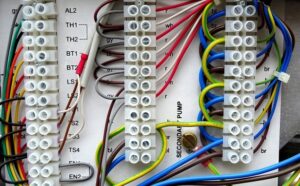
Hipot Testing: This test evaluates the ability of the cable and connector insulation to withstand high voltage without failure. By applying a specified voltage, hipot testing ensures that the insulation can handle electrical stress without breaking down. This is vital for preventing electrical shock hazards and ensuring safety under abnormal conditions.
Ground Bond Testing: This test confirms that the grounding connections of connectors provide a low-resistance path to the ground, which is essential for safety in the event of a fault. Effective ground bond testing helps ensure that fault currents are safely directed away from sensitive components.
Cables: Hipot Testing for Safe and Reliable Performance
The AI ecosystem includes various cables, including power, communication, management, and control cables, each with its own safety standards. Verifying cable insulation is a core part of cable and connector electrical safety testing — the UL 444 standard for communications cables requires hipot testing voltages that vary based on cable design, generally ranging from 0.75 kVac to 3 kVac (or 1 kVdc to 5 kVdc). The test duration is typically 2 seconds, and the cable must pass without any breakdown.
Connectors: Comprehensive Hipot and Ground Bond Testing
Connectors, crucial for data, signal, control, and power applications, also require rigorous testing as part of complete cable and connector electrical safety testing. Both hipot and ground bond tests are necessary for ensuring electrical safety. According to IEC 61984, hipot testing for connectors involves voltages from 0.37 kVac to 4.26 kVac, with higher-rated connectors tested up to 6.6 kVac. The test duration is 60 seconds. For ground bond testing, a current of 1.5 times the rated current is applied, with a maximum test current of 25A. The resistance between accessible metal parts and the ground should be less than 0.1Ω.
Associated Research Testing Solutions
To achieve precise and reliable cable and connector electrical safety testing, we recommend the HypotULTRA® Series Electrical Safety Tester. This series is well-suited for comprehensive hipot and ground bond testing, offering voltages up to 5 kVac and 6 kVdc, and featuring a ground bond testing capability of up to 40A. This ensures your components meet rigorous safety standards and perform reliably. Connectors typically require hipot testing between each pin; therefore, bundling with SC6540 Multiplexers simplifies the testing setup and solves complex wiring problems.
For applications requiring higher testing voltages, the HypotMAX® Series High Voltage Hipot Tester provides advanced solutions for demanding cable and connector electrical safety testing needs. The 7705 model supports up to 10 kVac, while the 7710 model offers up to 12 kVdc, catering to the most stringent testing requirements. These models are ideal for components requiring higher voltage safety verification.
As the landscape of AI and data infrastructure evolves, ensuring your manufactured components meet the highest safety standards through proper cable and connector electrical safety testing is crucial. If you are looking for testing solutions, please contact us.
FAQ
What is cable and connector electrical safety testing?
It’s testing that verifies cable and connector insulation can withstand high voltage (hipot testing) and that grounding paths safely direct fault current (ground bond testing).
What voltage range does UL 444 require for cable and connector electrical safety testing?
UL 444 generally requires hipot testing voltages between 0.75 kVac and 3 kVac (or 1 kVdc to 5 kVdc), depending on cable design, tested for approximately 2 seconds.
What does IEC 61984 require for connector testing?
IEC 61984 requires hipot testing from 0.37 kVac up to 6.6 kVac for higher-rated connectors (60-second duration), plus ground bond testing at 1.5x rated current (max 25A) with ground resistance below 0.1Ω.
Why is cable and connector electrical safety testing especially important for AI infrastructure?
AI systems depend on high-speed data transmission and substantial, stable power delivery between servers, GPUs, and data centers — any cable or connector failure can disrupt these connections and compromise system reliability.

