



Battery electrical safety testing requirements differ based on application — UL 2580 governs batteries used in electric vehicles (EVs), while UL 1973 covers batteries in stationary and motive auxiliary power applications, including energy storage systems. Both rely on Hipot testing to verify insulation integrity, but at different voltage ranges and test-point configurations.
The rapid surge of clean energy is pushing battery technology to the forefront, serving as the primary driver for the energy revolution. Batteries, spanning a spectrum of types, are pivotal players across diverse applications — from power batteries used in Electric Vehicles (EVs) to rechargeable batteries used in energy storage systems. Ensuring the safety, performance, and reliability of these batteries requires battery electrical safety testing before they go to market. This guide covers two major standards: UL 2580 for EV batteries, and UL 1973 for energy storage batteries — along with testing solutions built around both.
UL 2580: Battery Electrical Safety Testing for EVs
Ensuring the reliability and electrical safety of EV batteries is crucial for driver and passenger safety, making rigorous battery electrical safety testing imperative under UL 2580.
One of the key tests is the Hipot test. This test involves applying a specified testing voltage, typically ranging from 600 Vdc to 1200 Vdc, between the battery’s enclosure and the positive and negative terminals. The purpose is to assess insulation integrity and confirm the battery can withstand high voltage without leakage or breakdown.
Additionally, EV battery testing evaluates the potential for electrical shock hazards by applying test voltage between the accessible metallic part of the vehicle — such as the charging plug — and the battery’s positive and negative terminals. These tests verify the battery’s ability to operate safely within the full EV system.
UL 1973: Battery Electrical Safety Testing for Energy Storage Systems
Different from UL 2580, UL 1973 covers a wide range of battery applications in stationary and motive auxiliary power systems, with energy storage system batteries being one of them. Ensuring safety and stability in these systems is critical, which is why UL 1973 requires Hipot testing to evaluate electrical insulation integrity and the battery’s capability to withstand abnormal voltage scenarios.
In this test, a specified voltage is applied between the battery’s enclosure and its positive and negative terminals. The magnitude depends on the working voltage and insulation level of the battery — typically falling within 1kVdc to 4kVdc. For applications requiring specialized consideration, such as high-voltage systems, testing voltage may escalate significantly, reaching up to 20kVdc, ensuring the battery can endure high voltages without leakage or breakdown.
Battery Electrical Safety Testing Solutions
Whether the battery is used in an EV or an energy storage system, battery electrical safety testing often involves applying test voltage across multiple points, not just one connection. This complexity increases the potential for human error, which can lead to retesting, reduced efficiency, or — in critical cases — product recalls.
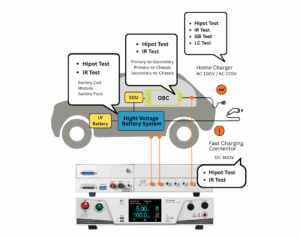
The HypotULTRA® Series Electrical Safety Tester paired with SC6540 Multiplexers delivers up to 6kVdc for Hipot testing and simplifies multi-point testing with a one-click solution — eliminating the need to switch test leads between each step.
With escalating energy storage capacities driving higher working voltages, more customers are seeking ultra-high Hipot test solutions. The HypotMAX® Series High Voltage Hipot Tester provides up to 20kVdc, ensuring safety for energy storage systems operating at these heightened voltage levels.
To learn more about battery electrical safety testing solutions, reach out to us today.
Key Takeaways
- Battery electrical safety testing requirements differ by application: UL 2580 for EV batteries, UL 1973 for stationary/energy storage batteries.
- UL 2580 Hipot testing typically ranges from 600 Vdc to 1200 Vdc; UL 1973 ranges from 1kVdc to 4kVdc, up to 20kVdc for high-voltage systems.
- Multi-point testing increases human error risk, making automated multiplexed setups valuable for battery manufacturers.
FAQ
What is battery electrical safety testing?
It’s a set of tests — primarily Hipot testing — that verify a battery’s insulation integrity and ability to withstand high voltage without leakage or breakdown, required under standards like UL 2580 and UL 1973.
What’s the difference between UL 2580 and UL 1973?
UL 2580 governs batteries used in electric vehicles, while UL 1973 covers batteries in stationary and motive auxiliary power applications, including energy storage systems.
What voltage range does UL 2580 battery electrical safety testing use?
UL 2580 Hipot testing typically applies 600 Vdc to 1200 Vdc between the battery enclosure and its terminals.
What voltage range does UL 1973 battery electrical safety testing use?
UL 1973 Hipot testing typically falls between 1kVdc and 4kVdc, though high-voltage systems may require testing up to 20kVdc.
If you wish to learn more about our battery solutions, we invite you to reach out to us today. Let us empower your journey towards enhanced safety and efficiency in the electrical safety test of batteries.

