



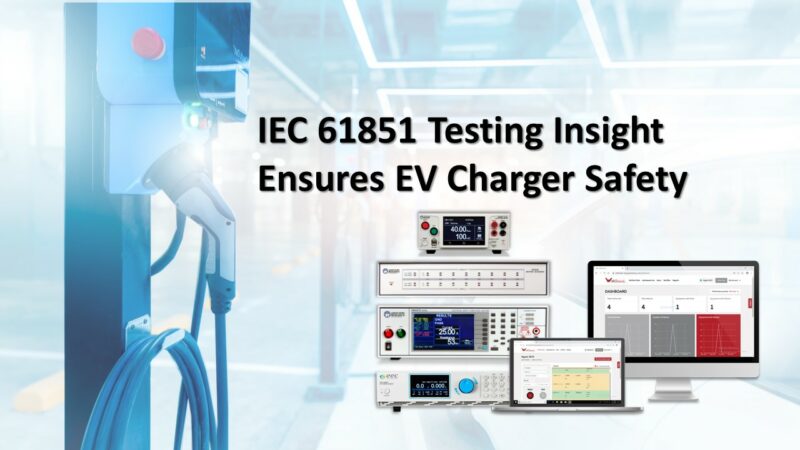
EV charging station testing under IEC 61851 covers four core tests — Hipot, Insulation Resistance, Leakage Current, and Ground Bond — with requirements varying by charger classification (Class 1 basic insulation vs. Class 2 reinforced insulation). As automakers standardize charging protocols and expand infrastructure, understanding these requirements is essential for charging station manufacturers.
The global EV market continues to thrive. As major automakers standardize charging protocols and accelerate EV adoption, an increasing number of EV charging station manufacturers require efficient EV charging station testing solutions to ensure product safety. This guide explores essential electrical safety standards like IEC 61851 and their testing requirements.
Understanding EV Charging Modes

Before exploring EV charging station testing requirements, it helps to understand the different types of charging stations. According to IEC 61851, EV charging modes fall into four categories based on power connection and shock protection:
| Mode | Description | Shock Protection |
|---|---|---|
| Mode 1 | Plugging an EV into a standard household socket | None — often restricted or banned due to safety concerns |
| Mode 2 | Similar to Mode 1, but uses a charging cable with built-in protection | Built into the cable |
| Mode 3 | AC charging station (wall-mounted or public) with a permanent power connection | Built-in protection |
| Mode 4 | DC fast charging station providing direct current power, typically at public charging locations | Built-in, permanent grid connection |
Key Electrical Safety Tests for EV Charging Stations
Electrical safety testing plays a pivotal role in ensuring the safety and quality of charging stations before they are used by consumers. A series of essential electrical safety tests is conducted, which includes Hipot, Ground Bond, Insulation Resistance, and Leakage Current tests. Notably, charging stations are classified into two categories: Class 1, which features basic insulation, and Class 2 chargers, equipped with reinforced insulation.
Hipot Test
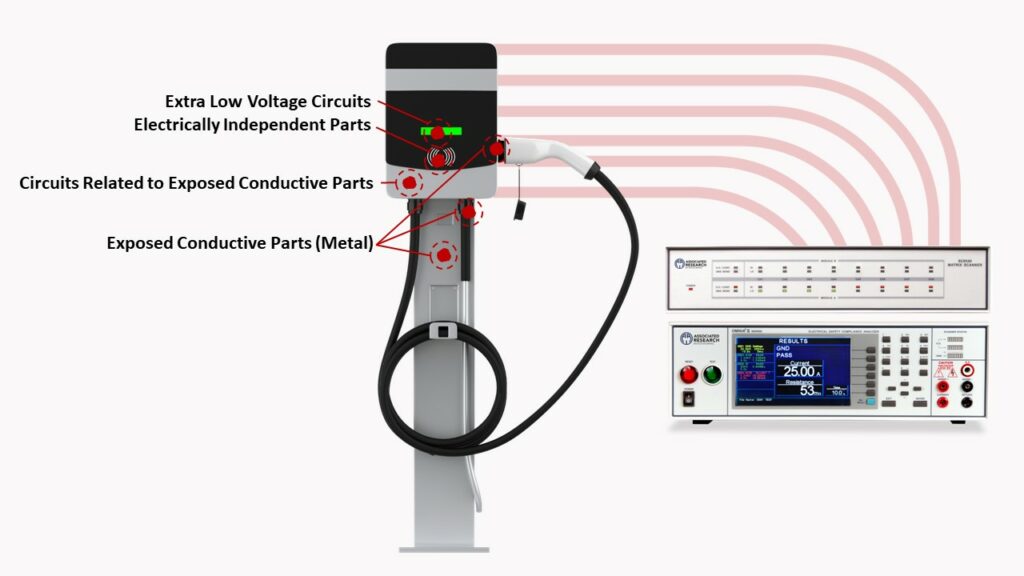
The Hipot test involves applying up to 4000V AC for 60 second to specific testing points on the charging station without experiencing any breakdown. Here are the specific testing details: Class 1 chargers require 2000V AC for testing points related to circuits with exposed conductive parts, exposed conductive parts, and electrically independent parts, while Class 2 chargers necessitate 4000V AC. Additionally, for both Class 1 and Class 2 chargers, a 4000V AC test is applied between the power circuit and extra-low voltage circuits.
Insulation Resistance Test
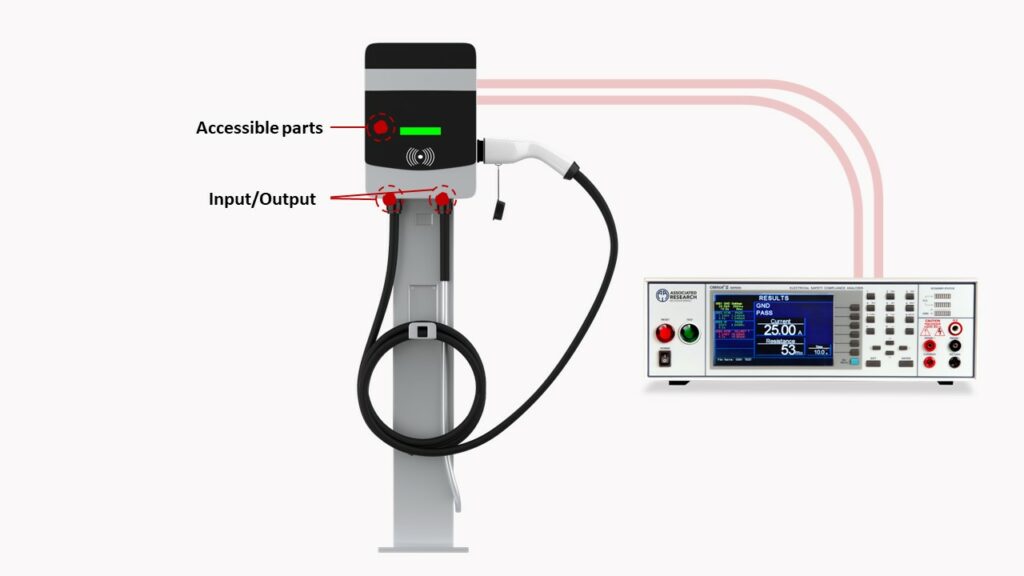
Insulation resistance test is applying 500V DC to the testing points between connected inputs/outputs and the accessible parts, with the measured resistance needing to exceed 1M ohms for Class I charging stations, or 7M ohms for Class II charging stations.
Leakage Current Test
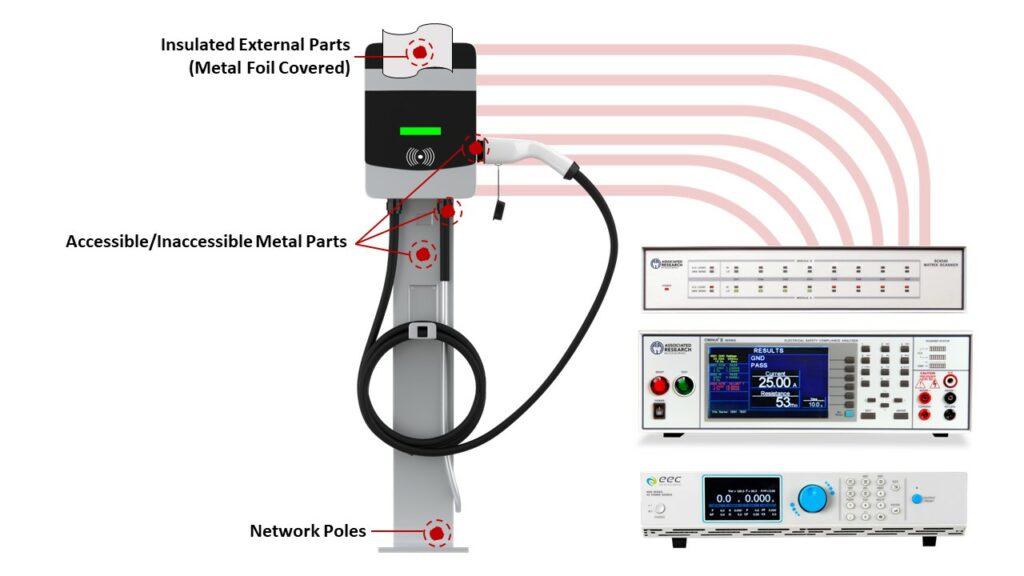
Leakage current test determines the current between AC supply network poles and the accessible metal parts connected together and insulated external parts with a metal foil covering. For Class 1, the leakage current should be less than 3.5mA, and for Class II, it should be less than 0.25mA. Additionally, Class II should also measure the leakage current between network poles and the metal inaccessible part and between connected accessible and inaccessible metal parts and insulated external parts with covering a metal foil. These values should be less than 3.5mA and 0.5mA, respectively.
Ground Bond Test
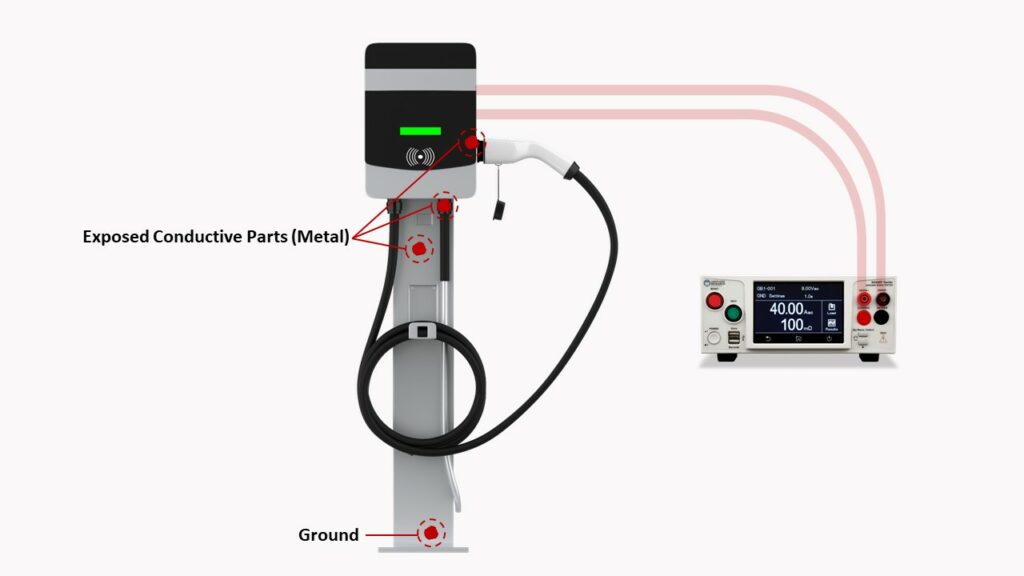
This test is only required for Class I charging stations by checking the electrical continuity between exposed conductive parts and the earth circuit. It entails applying a DC current of 16 A with a no-load voltage not exceeding 12 V between any exposed conductive part and the charging station’s earthing terminal. The resistance between these two points should not exceed 0.1 Ω.
Comprehensive Testing Solutions for EV Charging Stations
Ensuring the highest safety level for chargers involves managing complex aspects — particularly Hipot and leakage current tests performed at multiple points — making efficient EV charging station testing execution challenging. Many manufacturers have adopted a comprehensive, all-in-one solution built around three components:
OMNIA® II Multi-Function Electrical Safety Tester
The OMNIA® II Multi-Function Electrical Safety Tester integrates AC/DC withstand (ACW/DCW), insulation resistance, leakage current, and more into a single instrument.
SC6540 Multiplexers
Bundled with SC6540 Multiplexers, OMNIA® II becomes a multi-testing hub. Operators can program full testing sequences and use direct barcode connections to instantly associate products with pre-programmed test files — eliminating the need to switch testing leads for each point. This significantly improves efficiency and reduces connection errors.
WithStand® Software
WithStand® software ties the setup together, automating test data recording and tracking across the full testing sequence.
HYAMP® Ground Bond Tester
For Class 1 products that require DC ground bond testing, the HYAMP® Ground Bond Tester adds this capability to the setup. It combines AC and DC ground bond testing in a compact design, offering up to 40A current measurement capacity with high-precision performance.
FAQ
What is EV charging station testing under IEC 61851?
It’s a set of electrical safety tests — Hipot, Insulation Resistance, Leakage Current, and Ground Bond — required to verify EV charging stations meet IEC 61851 safety requirements before reaching consumers.
What’s the difference between Class 1 and Class 2 EV chargers?
Class 1 chargers have basic insulation and require ground bond testing, while Class 2 chargers have reinforced insulation, higher Hipot voltage requirements (4000V AC vs. 2000V AC), and stricter leakage current limits.
What are the four EV charging modes under IEC 61851?
Mode 1 (standard household socket, no protection), Mode 2 (cable with built-in protection), Mode 3 (AC charging station with permanent connection), and Mode 4 (DC supercharger).
Why is ground bond testing only required for Class 1 chargers?
Class 1 chargers rely on basic insulation and grounding for protection, so ground bond testing verifies the earth circuit continuity that Class 1 safety depends on — Class 2’s reinforced insulation doesn’t rely on this same protective grounding path.

