



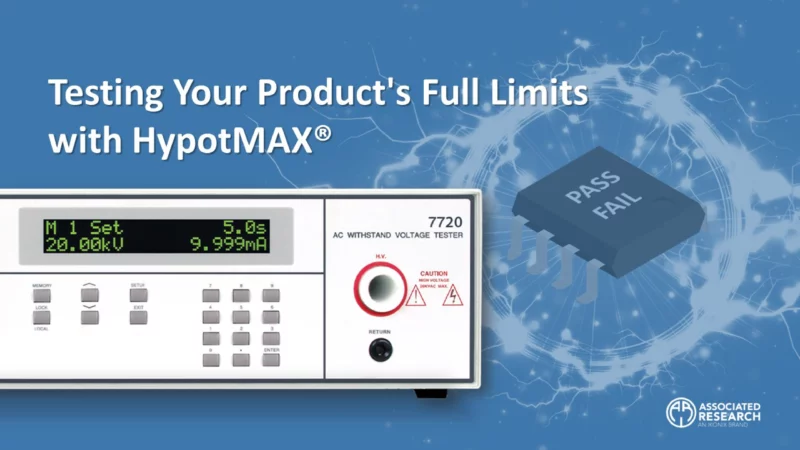
Ultra-high voltage hipot testing goes beyond standard compliance — typically capped at 5kVac or 6kVdc — to identify a product’s actual breakdown point, sometimes up to 20kVac. This article covers real examples across Battery Energy Storage Systems (BESS), IGBT gate drivers, thermal conductive pads, and insulated hand tools, showing why both voltage and test duration matter for uncovering hidden insulation issues.
Previously, we covered the ease of conducting the Hipot test and optimizing multi-point Hipot testing. But how can you push a product to its maximum strength, and what are its actual limits? Hipot testing can go beyond standard compliance — it can also help identify potential insulation issues by assessing the breaking point. While standards typically set a Hipot test voltage of up to 5kVac or 6kVdc, certain insulation issues require ultra-high voltage hipot testing for comprehensive detection. Testing time plays an equally important role.
Ultra-High Voltage Hipot Testing for Battery Energy Storage Systems
The Battery Energy Storage Systems (BESS) market is experiencing rapid growth. Typically, battery packs used in energy storage systems undergo Hipot testing with voltages ranging from 1kVac to 4kVac, applied between the battery pack’s terminals and enclosure. As battery applications and capacities advance, demand for elevated safety and quality requirements is growing — an increasing number of BESS customers now seek ultra-high voltage hipot testing solutions with test voltages raised up to 20kVac, enabling comprehensive assessment of battery pack insulation integrity.
In one case, a customer tested their product to the utmost requirement using type test parameters — applying 20kVac for 60 seconds. The general assumption is that if no breakdown occurs in the first 20 seconds, the product should pass. Notably, a battery pack failure occurred between 30 and 40 seconds into the test — underscoring how critical test duration is to ensuring true safety and quality.
Hipot Testing for Thermal Conductive Pads and Sheets
Thermal conductive pads and insulator sheets play a crucial, often overlooked role in electronics like MOSFETs, ICs, LEDs, and laptops. These sheets and pads are incredibly thin, making it difficult to inspect insulation quality or visually identify defects. The most efficient method involves placing them on a metallic surface and using high-voltage breakdown techniques to detect pinholes or thickness variations. Customers commonly apply 20kV ultra-high voltage hipot testing to these DUTs to ensure the highest quality delivery.
Ultra-High Voltage Hipot Testing for Insulated Hand Tools
Hand tools come in a wide range of types, and while most don’t require insulation, work environments with live parts rated up to 1000Vac and 1500Vdc require specialized insulated tools for worker safety. These tools use various insulation methods — components made of conductive materials partially covered by insulating material, or entirely conductive material with no exposed conductive points.
To meet the international standard IEC 60900, these tools must withstand 1kVac or 1.5kVdc. However, to ensure ultimate safety, the industry commonly applies a 10kVac ultra-high voltage hipot testing procedure — typically by immersing tools in an electric pool to assess insulation and identify faulty units.
Recommended Equipment
Ikonix provides an extensive range of Hipot testing solutions, with the HypotMAX® Series High Voltage Hipot Tester standing out for exceptional high-voltage performance. Designed with multiple configurations to perform both ACW and DCW tests, it offers voltage options from 10kV to 20kV, meeting industry standards across a range of ultra-high voltage hipot testing applications.
Ikonix also offers application consulting services to ensure operators fully understand electrical safety testing and safety precautions when conducting ultra-high voltage tests. Contact us to learn more about ultra-high voltage testing solutions.
FAQ
What is ultra-high voltage hipot testing?
It’s Hipot testing conducted at voltages significantly above standard compliance levels (typically above 5kVac/6kVdc, sometimes up to 20kVac) to identify a product’s actual insulation breakdown point.
Why does test duration matter in ultra-high voltage hipot testing?
Insulation failures don’t always occur immediately — one documented case showed a battery pack failing between 30 and 40 seconds into a 60-second test, despite surviving the initial 20 seconds.
What voltage do insulated hand tools need to withstand?
Under IEC 60900, insulated hand tools must withstand 1kVac or 1.5kVdc, though the industry commonly tests at 10kVac for added safety margin.
What equipment supports ultra-high voltage hipot testing?
The HypotMAX® Series High Voltage Hipot Tester offers ACW and DCW testing configurations from 10kV to 20kV, suited to BESS, semiconductor, and insulated tool applications.

