




Multi-point hipot testing — required for DUTs like EV batteries, energy storage systems, power adapters, and PCBs — introduces significant complexity beyond basic two-point testing. Manual lead switching between test points increases the risk of errors and prolongs testing time. Configuring a multiplexer to automate point-to-point switching solves this, enabling one-click testing across up to 80 channels.
In our previous issue on hipot test setup, we covered the foundational aspects of connecting a Device Under Test (DUT) to an electrical safety tester. However, certain DUTs — such as EV batteries, energy storage systems, power adapters, and PCBs — require more extensive testing involving multiple test points rather than just two. Multi-point hipot testing increases complexity and presents real challenges, even for experienced professionals.
Challenges in Multi-Point Hipot Testing
During multi-point hipot testing, personnel errors often lead to the unintentional applying high voltage to the same test point, neglecting certain test points, or even incorrect connecting test leads to the wrong test points. These errors not only affect the precision and reliability of testing results but also require re-conducting the tests. Moreover, when operators switch test leads to different points, it leads the aforementioned issues and prolongs the overall testing time. Ultimately, these factors collectively result in a notable decrease in testing efficiency and raise concerns about potential safety issues.
Taking a power adapter as an example, the process of applying high voltage becomes more complex. Unlike the standard Hipot test connection between two points: shorted fire and line prongs, and the chassis, testing must occur between the primary side and ground, the secondary side and ground, and the primary side and the secondary side. Therefore, within this complexity, the aforementioned errors could occur. Preventing these errors is a big challenge for testing personnel.
Optimizing Multi-Point Hipot Testing Solution
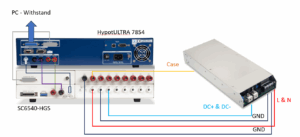
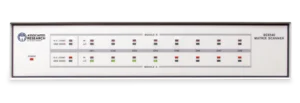
Given these challenges, simplifying the Hipot testing approach to be initiated with just a click is a way to solve them. It eliminates the need for operators to repeatedly connect testing leads, thereby significantly reducing the risk of errors. The Associated Research SC6540 holds the key to addressing these challenges. The Multiplexers integrate with the HypotULTRA® and OMNIA® II, effectively creating a versatile multi-testing hub. Each channel of the SC6540 Scanner’s functions can be finely tailored to fulfill distinct testing roles. Continuing with the power adapter example:
- Channel 1 connects to the primary side
- Channel 2 connects to the ground
- Channel 3 connects to the secondary side
Each channel can be designated as High (H) for high-voltage testing output, Low (L) for the return connection, or set as Open (O) signifying a non-operational status. This configuration process is facilitated through the intuitive menu of the electrical safety tester or, alternatively, through the user-friendly WithStand® automation software.
Multiplexers
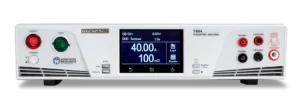
HypotULTRA®
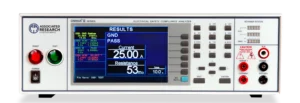
OMNIA® II
Example Step Test Configuration
- Step 1: Channel 1 as H, channel 2 as L, and the remaining channels as O
- Step 2: Channel 3 as H, channel 2 as L, and the remaining channels as O
- Step 3: Channel 1 as H, channel 3 as L, and the remaining channels as O
Furthermore, you can expand your testing capabilities while optimizing efficiency by connecting up to 80 channels. This enables you to perform testing on multiple DUTs with a single click or tailor the setup to match your specific testing needs. If space is limited in the workstation, the EEC SE-7441 Electrical Safety Analyzer, which comes with built-in scanners (8 high voltage and 8 high current), could be a suitable option.
This optimized approach to multi-point hipot testing enhances both efficiency and precision by improving test configuration and methodology.
FAQ
What is multi-point hipot testing?
It’s Hipot testing performed across more than two test points — required for complex devices like EV batteries, power adapters, and PCBs — rather than the standard two-point connection.
What causes errors in multi-point hipot testing?
Manual lead switching between test points commonly causes errors: unintentionally retesting the same point, skipping points, or connecting leads to the wrong point.
Does IEC 62368-1 require multi-point hipot testing?
Yes — IEC 62368-1, the safety standard for audio/video, IT, and communication equipment, often requires hipot testing across multiple input, output, and ground combinations, similar to the multi-point testing needed for devices like power adapters and PCBs.
How many channels can be connected for multi-point hipot testing?
Up to 80 channels can be connected, allowing testing on multiple DUTs simultaneously or configurations tailored to specific testing needs.

