



BESS Hipot testing requirements differ significantly between battery modules and Battery Management Systems (BMS) — modules typically test at 1–3kVAC, while BMS require up to 3.8kVAC across multiple critical points. Governed by IEC 62933-5-2, this testing is central to ensuring Battery Energy Storage System (BESS) safety and reliability.
With the shared objective of achieving net-zero emissions by 2050, per the United Nations, governments and companies worldwide are collaborating to advance energy storage technologies. This commitment has fueled a flourishing market — the global distributed energy storage system market is projected to reach USD 12.44 billion by 2032. Batteries play a central role in these systems, commonly referred to as Battery Energy Storage Systems (BESS), and BESS Hipot testing is one of the most critical safety checks in ensuring their reliability.
Battery Energy Storage System Overview
BESS encompass technologies enabling efficient energy storage for later use, balancing electricity supply and demand. A comprehensive BESS comprises several essential components: temperature control systems maintain optimal battery operating conditions, fire extinguishing systems provide critical safety measures, power conversion systems (PCS) convert stored energy into desired output, energy management systems (EMS) monitor and control energy flow, and battery management systems (BMS) regulate battery performance and safety. Batteries are organized into modules and integrated with BMS to create a complete battery system. Battery quality directly impacts risks associated with BESS, including fire, explosion, and electrical shock — which is why BESS Hipot testing matters so much.
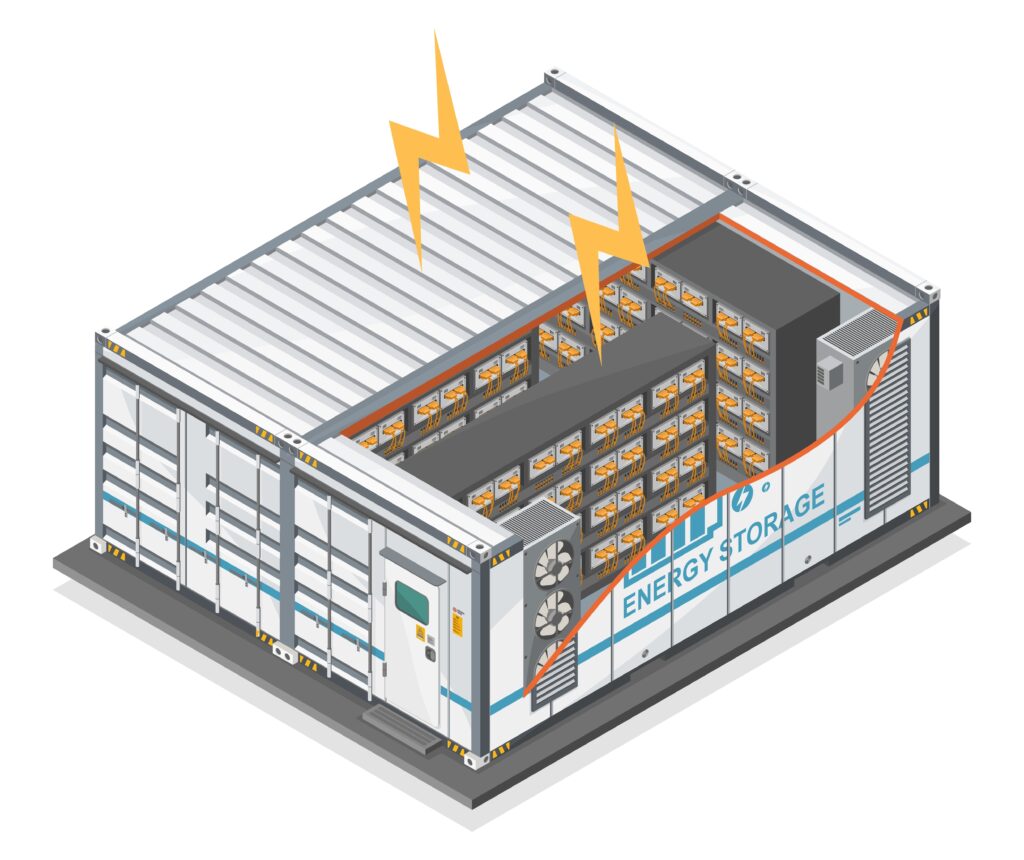
Recognizing the importance of safety, the IEC 62933-5-2 (Safety Requirement for BESS) places significant emphasis on BESS safety through a series of testing requirements. One critical test is the Hipot test, which evaluates both the battery module and BMS. This test is essential for identifying potential faults and ensuring optimal performance of these components to ensure their safety and reliability.
Battery Module and BMS Testing Methods
Specific BESS Hipot testing methods vary depending on whether battery modules or BMS are being tested:
| Component | Test Voltage | Test Points | Duration |
|---|---|---|---|
| Battery Module | 1–3 kVAC (determined by working voltage) | Positive terminal to chassis; negative terminal to chassis | ~60 seconds |
| BMS | Up to 3.8 kVAC | Input terminals (energy source to chassis); communication terminals; output terminals (battery positive/negative to chassis); communication terminals | — |
BMS require higher testing voltages and more test points than battery modules, since they carry both power and communication connections that each need independent verification.
Ikonix’s Solution for BESS Hipot Testing
Many customers encounter challenges managing multiple testing points during BESS Hipot testing — the complexity and volume of points can lead to errors and production disruptions. Automating the testing procedure and minimizing mistakes is essential, along with efficient recording of results across multiple points.
HypotULTRA® Series Electrical Safety Tester
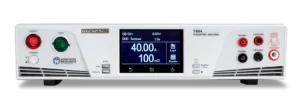
The HypotULTRA® Series Electrical Safety Tester is the optimal choice for battery modules and BMS, providing up to 5kVAC output to meet testing requirements. When working with high voltages, operator safety is paramount — HypotULTRA® includes SmartGFI® features to prevent electrical shock, and pairing it with personal protective equipment (PPE) like insulation mats adds another layer of protection.
SC6540 Multiplexers
For customers requiring multi-point BMS testing, HypotULTRA® integrates with SC6540 Multiplexers to further enhance efficiency, eliminating frequent test lead switching and resolving complex cable connections — saving time and reducing unnecessary mistakes.
WithStand® Software
WithStand® software further automates the testing process with remote instrument control and barcode scanning to automate test file loading, eliminating manual errors. The software also supports secure data storage and tracking, whether in the cloud or on a local computer.
Contact us today to learn more about Ikonix’s complete solutions for optimizing your BESS Hipot testing workflow.
FAQ
What voltage is used in BESS Hipot testing for battery modules?
Battery modules typically undergo Hipot testing at 1–3kVAC, determined by working voltage, applied between the positive/negative terminals and chassis for approximately 60 seconds.
What voltage is used in BESS Hipot testing for BMS?
BMS require higher voltages, potentially up to 3.8kVAC, tested across input terminals, output terminals, and communication terminals.
What standard governs BESS Hipot testing?
IEC 62933-5-2 governs safety requirements for grid-integrated electrochemical-based energy storage systems, including Hipot testing requirements for BESS components.
Why does BMS testing require more test points than battery module testing?
BMS carry both power and communication connections that each require independent verification, unlike battery modules which primarily need terminal-to-chassis testing.

