



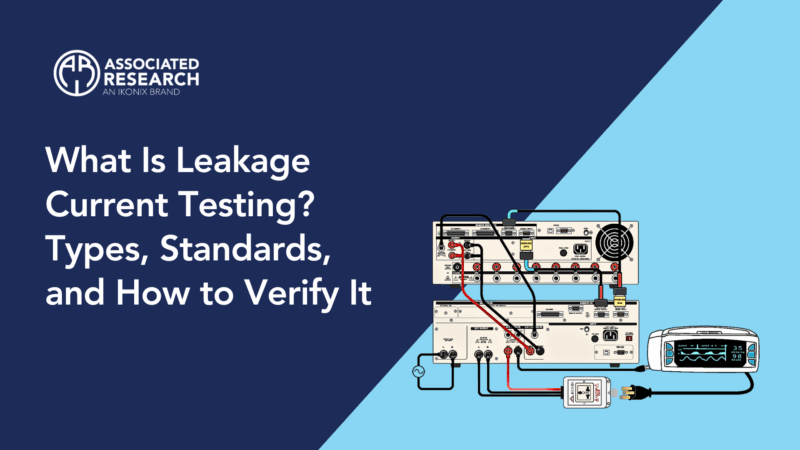
Before understanding leakage current testing, it is important to identify what is leakage current. Leakage current is the small amount of current that flows through a path that isn’t part of a product’s intended circuit, most often through insulation, over a surface, or through stray capacitance. It happens in every electrical product to some degree. The concern isn’t whether leakage current exists, it’s whether it stays low enough that a person contacting the product, or a conductive part of it, isn’t exposed to a hazardous shock.
Because leakage current is normal at low levels, standards define maximum allowable limits rather than requiring zero leakage. Those limits vary depending on the type of equipment, how it’s connected to the person using it, and which safety standard applies.
Leakage Current Testing vs. Hipot, Insulation Resistance, and Ground Bond Testing
These four tests are often run together as part of the same electrical safety sequence, but each one checks something different.
- Hipot test: applies a high voltage briefly to check whether the insulation can withstand voltage well above normal operating levels without breaking down.
- Insulation resistance test: applies a lower, steady DC voltage and measures resistance, catching gradual insulation degradation before it becomes a hipot failure.
- Ground bond test: confirms the chassis has a low-resistance path to ground, so fault current has somewhere safe to go.
- Leakage current test: measures the current a person would actually be exposed to under normal or single-fault operating conditions, with the product powered and running rather than being stressed with an external test voltage.
Leakage current testing is the only one of the four performed with the product energized and operating close to its normal condition, which is what makes it a useful complement to the other three rather than a replacement for any of them.
The Five Leakage Current Types Under IEC 60601-1
Medical electrical equipment standards, led by IEC 60601-1, define leakage current more precisely than general product safety standards do, breaking it into five distinct measurements:
- Earth leakage current: current flowing from the mains through or across the insulation into the protective earth conductor.
- Enclosure (touch) leakage current: current flowing from an exposed conductive part of the enclosure to ground, measuring what a person touching the case could be exposed to.
- Patient leakage current: current flowing from an applied part, through a patient, to ground, under normal conditions.
- Patient auxiliary leakage current: current flowing between two applied parts on the same patient that isn’t intended to produce a physiological effect.
- Mains on applied part leakage current: current that would flow to a patient if mains voltage were accidentally applied to an applied part, a single-fault condition test.
Non-medical products don’t always require all five measurements, but earth leakage and enclosure leakage are common across most general product safety standards, not just medical device standards.
Which Standards Require Leakage Current Testing
Leakage current limits show up across several major product safety standards, each with its own allowable values depending on equipment class and intended use:
- IEC 60335-1: household and similar electrical appliances.
- IEC 62368-1: audio, video, IT, and communication equipment.
- IEC 60601-1: medical electrical equipment, with the five leakage current types described above.
- IEC 61010-1: laboratory, measurement, and industrial control equipment.
Allowable limits differ by standard and by equipment class, generally expressed in microamps or milliamps depending on the current type and the level of protection the product is rated for. A double-insulated consumer appliance and a patient-connected medical device are held to very different thresholds, so the applicable standard has to be identified before a limit can be applied.
Basic Leakage Current Test Procedure
- Power the device under test at its rated operating voltage, since leakage current is measured under normal operating conditions rather than an elevated test voltage.
- Select the leakage current type being measured, since the test setup differs between earth leakage, enclosure leakage, and patient leakage measurements.
- Connect the measuring network between the relevant points, such as the enclosure and ground for enclosure leakage, or an applied part and ground for patient leakage.
- Record the reading under normal condition, then repeat under relevant single-fault conditions, such as an open ground or reversed polarity, where the applicable standard requires it.
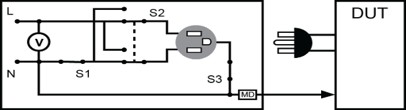
Leakage current test circuit with normal/fault switching
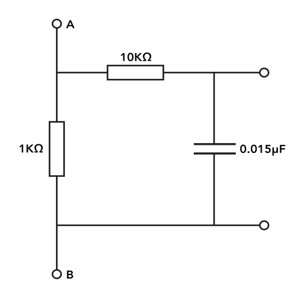
Measuring device (MD) network
- Compare each reading against the allowable limit for that leakage current type and equipment class.
Choosing Leakage Current Test Equipment
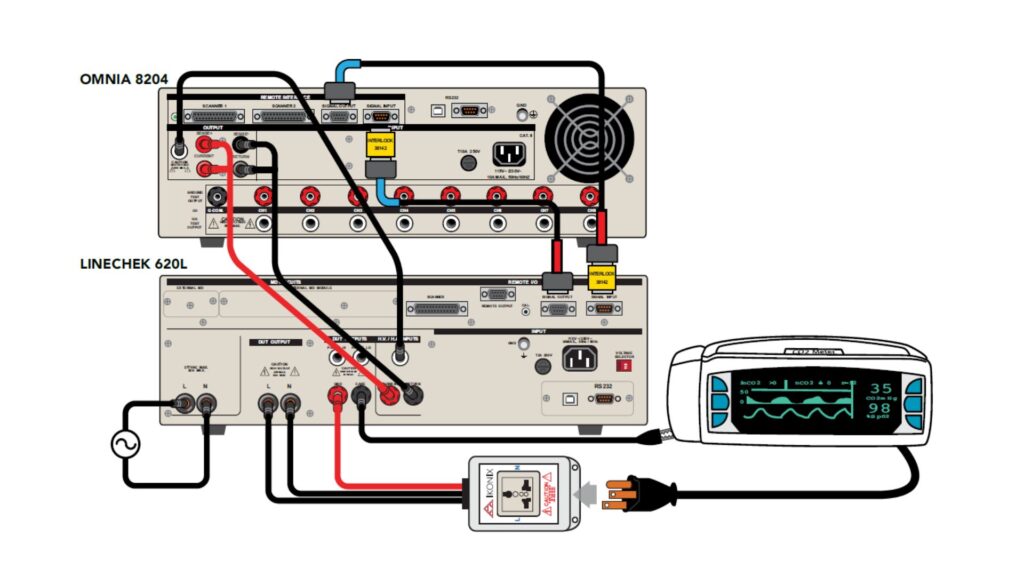
Look for a tester built to measure the specific leakage current types your product’s applicable standard requires, since a general-purpose leakage current meter may not support the applied-part measurements IEC 60601-1 calls for. If leakage current testing is part of a broader safety sequence alongside hipot, insulation resistance, and ground bond, an instrument that combines all four, like the OMNIA II, keeps the full sequence on one platform. For standalone leakage current measurement, including the medical-device-specific leakage current types, the LINECHEK II is built specifically for that purpose.
FAQ
- What is leakage current testing? Leakage current testing measures the small current that flows from a product’s live parts to ground, to its enclosure, or to a person touching it, confirming that current stays below the level considered safe for human contact.
- How is leakage current testing different from a hipot test? A hipot test applies a high voltage briefly to check for insulation breakdown. A leakage current test measures current under the product’s normal operating voltage, reflecting what a person would actually be exposed to during real use rather than under test stress.
- What are the five types of leakage current under IEC 60601-1? Earth leakage current, enclosure (touch) leakage current, patient leakage current, patient auxiliary leakage current, and mains on applied part leakage current.
- Which standards require leakage current testing? IEC 60335-1, IEC 62368-1, IEC 60601-1, and IEC 61010-1 all define leakage current limits, with the applicable limit depending on the equipment class and standard.

