



If you run electrical safety testing on a production line, you’ve probably seen measurement uncertainty happen: a DUT fails a Hipot or leakage current test, gets pulled and re-tested by hand, and passes the second time with no changes made. Nothing about the DUT changed between the two tests. So what did?
In most cases, it isn’t the DUT. It’s the gap between your instrument’s accuracy and your test limit.
The Problem Hides In The Spec Sheet, Not The DUT
Every Hipot tester has a published accuracy specification, usually something like “± 2% of reading + a fixed number of counts.” That specification defines a range around any displayed value, not a single exact number. A reading of 0.45 mA doesn’t mean the true current is exactly 0.45 mA; it means the true value falls somewhere inside a band around that number.
Most of the time, this doesn’t matter because most DUTs produce test results comfortably within the acceptable range. The issue arises when a DUT’s actual value falls close to the pass/fail threshold. If your measurement uncertainty is wide enough, a single DUT can have a true value that reads as a pass and sometimes as a fail. Not because the DUT changed, but because the reading itself has room to move.
A Real-World Look at Measurement Uncertainty
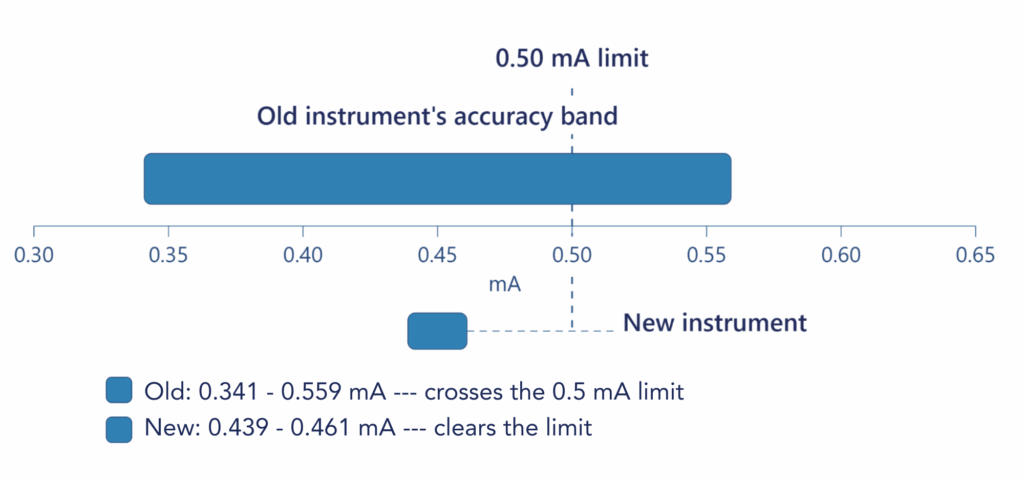
Say your Over Current limit is set to 0.5 mA, and a DUT displays a reading of 0.45 mA, comfortably under the limit, on paper.
Now apply a typical accuracy specification: ± 2% of reading + a fixed count offset. At that current level, this might produce an accuracy band of roughly ± 0.1 mA around the displayed value. That means the DUT’s true current could plausibly be anywhere from about 0.34 mA to 0.56 mA, a range that straddles the 0.5 mA limit itself.
In other words, a “passing” 0.45 mA reading and a “failing” 0.51 mA reading might represent the exact same physical DUT. The instrument isn’t malfunctioning in either case. It’s operating inside its own stated tolerance. The tolerance is just wide enough, relative to the limit, to make the call ambiguous.
Accuracy vs. Repeatability: How To Tell If This Is Happening To You
A few signs point toward a measurement uncertainty problem rather than a real quality issue:
- Failed DUTs pass on a manual re-test with no rework
- Failures cluster near the limit rather than being spread across the full range
- When you’ve confirmed that the test result’s reading is within instrument specification
- You’ve already loosened your limit or added a buffer to reduce nuisance failures
None of these mean your DUTs are the issue, but rather the instrument’s accuracy and the pass/fail limit are close enough together that measurement uncertainty is doing some of the rejecting.
How to Determine Whether Measurement Uncertainty Is the Problem
You don’t need to guess. Take your instrument’s published accuracy specification at your test’s current or voltage level, and compare that tolerance band to your limit:
- Find your accuracy spec at the relevant test point (often listed as “± X% of reading + Y counts”)
- Calculate the resulting band around a typical near-limit reading
- Check whether that band crosses your set limit
If it does, some fraction of your borderline DUTs are being decided by measurement noise, not by the DUT itself. The closer your typical readings sit to your limit, the more this matters — a limit set well above where your DUTs normally read is far less exposed than a limit that DUTs commonly test close to.
What Can You Do About Borderline Hipot Test Results?
Loosening the limit reduces the symptom but not the cause, and it can mean genuinely marginal DUTs start passing. The more direct fix is using instrumentation with a tighter accuracy specification relative to your test point. One where the accuracy band at your typical reading doesn’t reach your limit.
Before switching anything, it’s worth confirming the fix on your own hardware rather than on a spec sheet alone: the same fixtures, the same cables, the same DUTs, with only the tester swapped. That’s the only way to know whether the ambiguous zone actually goes away for your specific setup.
FAQ
Q: Why does a good DUT fail Hipot testing and then pass on a retest?
A: In most cases it isn’t the DUT — it’s measurement uncertainty. Every Hipot tester has a published accuracy specification (often “± X% of reading + a fixed number of counts”), so any displayed reading represents a band of possible true values, not a single exact number. When a DUT’s true value sits close to your pass/fail limit, that accuracy band can straddle the limit, so the same physical DUT can read as a pass one moment and a fail the next — nothing about the DUT changed.
Q: How do I know if measurement uncertainty is causing my Hipot test failures?
A: A few signs point to a measurement uncertainty problem rather than a real quality issue: failed DUTs pass a manual retest with no rework, failures cluster near your limit rather than spreading across the full range, or you’ve already loosened your limit or added a buffer just to reduce nuisance failures. To confirm it, take your instrument’s accuracy spec at your test’s current or voltage level, calculate the resulting band around a typical near-limit reading, and check whether that band crosses your set limit.
Q: What can I do about borderline Hipot test results caused by measurement uncertainty?
A: Loosening the limit only hides the symptom — it can let genuinely marginal DUTs pass. The more direct fix is instrumentation with a tighter accuracy specification relative to your test point, so the accuracy band around your typical reading doesn’t reach the limit. Before switching anything, confirm the fix on your own hardware — same fixtures, cables, and DUTs, only the tester swapped — to be sure the ambiguous zone actually goes away for your setup.
