




Electrical safety testing in product development isn’t a single checkpoint — it plays a distinct role at each stage of the product lifecycle: R&D, pilot production, and mass production. Understanding what each stage requires helps manufacturers catch design flaws early, validate real-world performance, and maintain consistency at scale.
Launching a new product moves through several stages: idea generation, Research & Development (R&D), pilot production, and mass production. At each step, electrical safety testing plays a different but essential role — ensuring products meet safety standards, are ready for market entry, and protect consumers, consistent with quality management frameworks like ISO 9001.
R&D Stage: Early Detection of Design Flaws
During R&D, electrical safety testing in product development verifies that a product’s design meets relevant safety standards before it advances to the prototype or pilot stage. Catching design flaws at this point prevents costly downstream delays and helps accelerate the overall product launch timeline.
Pilot Production: Testing for Real-World Conditions
In pilot production, electrical safety testing in product development shifts toward validating performance under real-world operating conditions across varied environments. Manufacturers often adjust test methods at this stage — for example, increasing test voltage to accelerate results — to confirm the product can meet the more rigorous requirements it will face in mass production.
Mass Production: Ensuring Quality and Efficiency at Scale
At the mass production stage, electrical safety testing in product development shifts focus to consistency across every unit produced. Automated testing solutions matter most here: they reduce human error, eliminate unnecessary retesting, and improve overall throughput. Combining automated testing with increased test voltage lets manufacturers shorten test cycles while still confirming every unit is safe for market.
Choosing Testing Instruments That Work Across All Stages
Each development stage has different priorities, but applying the same testing instruments throughout the product lifecycle — rather than switching equipment from stage to stage — improves consistency, streamlines electrical safety testing in product development, and reduces requalification effort.
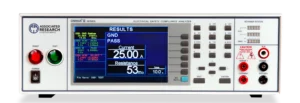
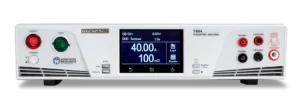
For R&D and pilot production, multi-function analyzers such as the OMNIA II® Electrical Safety Compliance Analyzer (7-in-1 testing) and HypotULTRA® Electrical Safety Compliance Analyzer (4-in-1 testing) let engineers run all necessary electrical safety tests on a single instrument — helping detect design flaws early and simulate real-world conditions without switching equipment.
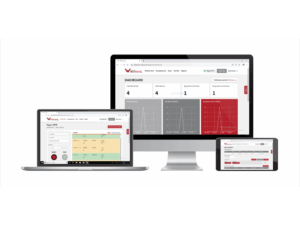
The same OMNIA II® and HypotULTRA® Series instruments carry through into mass production for consistency. For products requiring multi-point testing — such as medical devices or batteries — adding the SC6540 Multiplexer lets operators connect leads once while the instrument automatically steps through each test point, reducing operator error and speeding up production. Pairing this with WithStand® testing software and barcode-scanning further improves accuracy and helps manufacturers hit tight production schedules.
Conclusions for Electrical Safety Testing In Product Development
- Electrical safety testing in product development serves a different purpose at each stage: flaw detection in R&D, real-world validation in pilot production, and consistency at scale in mass production.
- Using consistent testing instruments across all stages reduces requalification effort and improves result reliability.
- Multi-point testing and automated software reduce operator error and support faster, more consistent mass production.
FAQ
When should electrical safety testing start in product development?
Testing should begin during the R&D stage, where it verifies the product design meets relevant safety standards before moving to prototyping or pilot production.
Why does test voltage sometimes increase during pilot production?
Increasing test voltage during pilot production helps validate that a product can meet the more rigorous safety requirements it will face during mass production, while also accelerating test results.
Why use the same testing equipment across R&D, pilot, and mass production?
Using consistent instruments throughout the product lifecycle improves result consistency and reduces the time needed to requalify testing procedures at each new stage.
What role does automation play in mass production testing?
Automated testing reduces human error, eliminates unnecessary retesting, and increases throughput — critical for meeting production schedules without compromising safety compliance.

