




AC vs DC hipot testing comes down to five key factors: regulatory acceptance, leakage current measurement accuracy, output power requirements, test setup complexity, and voltage equivalence. While product specifications and industry standards often dictate the method, understanding these tradeoffs helps manufacturers make an informed choice when they have flexibility.
Ensuring product safety in manufacturing is paramount, with the Hipot Test serving as a cornerstone method to achieve this goal. While the choice in AC vs DC hipot testing largely depends on product specifications and industry standards, manufacturers sometimes need to decide on the method themselves — and often encounter challenges due to a lack of clarity about each method’s advantages. This guide explains the differences between AC and DC Hipot testing and their respective advantages, helping you choose the proper testing method.
Key Differences in AC vs DC Hipot Testing
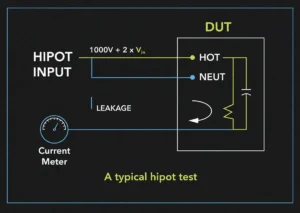
Several factors matter when comparing AC vs DC hipot testing: acceptance by safety regulatory agencies — including standards such as IEC 61010-1 — leakage current measurement accuracy, output power requirements, test setup complexity, and testing voltage equivalence.
Regulatory Acceptance: AC Hipot is more widely accepted by safety regulatory agencies than DC Hipot, since most products operate on AC power. AC Hipot can test both positive and negative polarities simultaneously, simulating the actual usage environment. DC Hipot, in contrast, only performs single-polarity tests — an important consideration if the product itself runs on AC voltage.
Leakage Current Accuracy: When applying AC test voltage, insulation generates a reactive current distinct from leakage current — often much larger — making true leakage current difficult to measure accurately. With DC Hipot testing, the initial charging current from capacitance gradually diminishes over time, allowing for precise measurement of actual leakage current.
Output Power Requirements: AC Hipot typically requires higher output current since it must continuously supply current for the tested product’s stray capacitance. DC Hipot has lower output power requirements, since charging current is only needed briefly.
Test Setup Complexity: AC Hipot testing avoids instantaneous surge currents since it can’t fully charge stray capacitors, eliminating the need for voltage ramp-up settings or post-test discharging. DC Hipot testing starts at zero and ramps up slowly to prevent excessive charging currents that could trigger a false tester shutdown — and requires discharging after testing to prevent electrical hazards.
Voltage Equivalence: During AC Hipot, peak voltage is 1.414 times the displayed RMS value on the voltmeter — a figure typically not shown directly. Most safety standards require DC Hipot test voltage to be increased to an equivalent value using the formula: DC Hipot Test Voltage = AC Hipot Test Voltage × 1.414. This ensures DC testing applies the same insulation stress as AC testing would.
Advantages at a Glance: AC vs DC Hipot Testing
| AC Hipot Advantages | DC Hipot Advantages |
|---|---|
| More widely accepted by safety regulatory agencies | Leakage current measurement more accurately reflects true current |
| No voltage ramp-up or discharge setup required | Testing can be conducted with lower output currents |
Choosing the Right Tester for AC vs DC Hipot Testing
Once you’ve decided between AC vs DC hipot testing, selecting the right tester matters just as much as the method itself. The Hypot® Series offers versatile options, providing up to 5kVac AC hipot and 6kVdc DC hipot, covering a wide range of testing requirements. For specialized ultra-voltage applications, the HypotMAX® Series delivers up to 20kVac AC hipot and 20kVdc DC hipot. Both feature RAMP-HI and discharge safety mechanisms to prevent false failures during DC Hipot testing and protect operator safety.
For deeper guidance, Ikonix’s application consulting service can help determine the right method and equipment for your specific testing requirements.
Key Takeaways
- AC vs DC hipot testing tradeoffs center on regulatory acceptance, leakage accuracy, power requirements, and setup complexity.
- AC Hipot is generally preferred by regulators and requires no ramp-up or discharge steps.
- DC Hipot provides more accurate leakage current measurement and requires lower output current.
- DC Hipot test voltage must be increased by a factor of 1.414 to match the insulation stress of AC testing.
FAQ
What is the main difference between AC and DC hipot testing?
AC Hipot tests both polarities simultaneously and is more widely accepted by regulators, while DC Hipot tests a single polarity but provides more accurate leakage current measurement.
Why is DC hipot test voltage higher than AC hipot voltage?
Because AC peak voltage is 1.414 times its displayed RMS value, DC Hipot voltage must be increased by that same factor (× 1.414) to apply equivalent insulation stress.
Does DC hipot testing require discharging after the test?
Yes — since DC Hipot testing charges the product under test, discharging afterward is necessary to prevent potential electrical hazards.

