




EV battery production reliability depends heavily on consistent, accurate hipot and ground bond/continuity testing. As battery manufacturers scale production to meet growing EV demand, simplifying these tests into a streamlined, one-click process reduces operator error and strengthens overall reliability without sacrificing compliance.
It’s no surprise that at this year’s Shanghai Auto Show, many companies debuted new electric vehicle lineups. Meeting such promising demand, the EV battery market is expected to experience significant growth in the coming years — according to Report Linker’s analysis, the global EV battery market is projected to grow at a compound annual growth rate (CAGR) of 19.57% from 2022 to 2027. As a result, battery manufacturers are focused on increasing EV battery production capacity while maintaining the reliability that keeps automakers competitive. What actually establishes a reliable battery?
Optimizing Electrical Safety Testing for EV Battery Production Reliability
To maintain EV battery production reliability, manufacturers should focus on optimizing the production line’s electrical safety testing process. Before batteries can be used in EVs, they must pass the Hipot test, which applies twice the rated voltage (usually 600 Vdc to 1200 Vdc) for 60 seconds across multiple points — including positive terminal to chassis, and negative terminal to chassis — to detect any battery breakdown.
Additionally, the ground bond/continuity test applies 25A DC current to verify ground resistance stays below 0.1 Ω, helping prevent potential safety incidents. Simplifying these tests into a one-click process — eliminating the need for operators to repeatedly switch testing leads — reduces the likelihood of errors, directly improving both testing efficiency and EV battery production reliability.
Reliable Testing Equipment for EV Battery Production
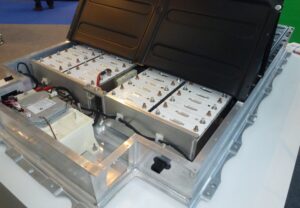
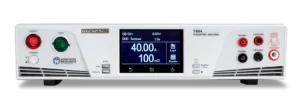
To optimize production line testing and improve EV battery production reliability, choosing the right testing solution is key. Manufacturers can pair the HypotULTRA® Series Electrical Safety Tester model 7850 with a built-in scanner module, the HYAMP® Ground Bond Tester, and WithStand® software.
The HypotULTRA® Series is an all-in-one solution offering improved test simplicity, safety, and reliability. It provides up to 5kVac/6kVdc Hipot voltage, meeting standard testing requirements, with an intuitive touch panel and built-in scanner that eliminates the need to switch testing leads. SmartGFI® and fast discharge features prioritize operator safety, while the barcode scanner enables direct data capture, preventing result mix-ups.
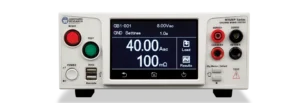
The HYAMP® 3240 Ground Bond Tester combines AC and DC ground bond testing capability in a compact design, offering maximum 40A current measurement and high-accuracy performance.
Both devices integrate with WithStand® software, letting operators easily set up and run tests, record data, and store it in the cloud for easy access and analysis — strengthening EV battery production reliability at every stage of testing.
If hands-on training would help your team, Ikonix also offers application consultants to support your understanding of electrical safety tests and improve testing efficiency and productivity.
Key Takeaways
- EV battery production reliability depends on consistent, accurate hipot and ground bond testing, not just faster test cycles.
- Hipot testing applies 600–1200 Vdc across multiple terminal-to-chassis points; ground bond testing applies 25A DC current with a 0.1 Ω resistance limit.
- Pairing HypotULTRA® with HYAMP® and WithStand® software reduces manual lead-switching and improves data accuracy.
FAQ
What tests affect EV battery production reliability most?
Hipot and ground bond/continuity testing are the two core tests that most directly affect EV battery production reliability, verifying insulation integrity and safe grounding respectively.
What voltage is used in EV battery hipot testing?
Typically twice the rated voltage, usually between 600 Vdc and 1200 Vdc, applied for 60 seconds across multiple terminal-to-chassis points.
What is the ground resistance requirement for EV battery ground bond testing?
Ground resistance must stay below 0.1 Ω when 25A DC current is applied, helping prevent potential safety incidents.
How can manufacturers improve EV battery production reliability during testing?
Simplifying hipot and ground bond tests into a one-click process — rather than manually switching test leads between points — reduces operator error and improves consistency.
If you need hands-on training on EV testing, Ikonix also offer application consultants to help you and your team understand the electrical safety tests and improve testing efficiency and productivity.

