



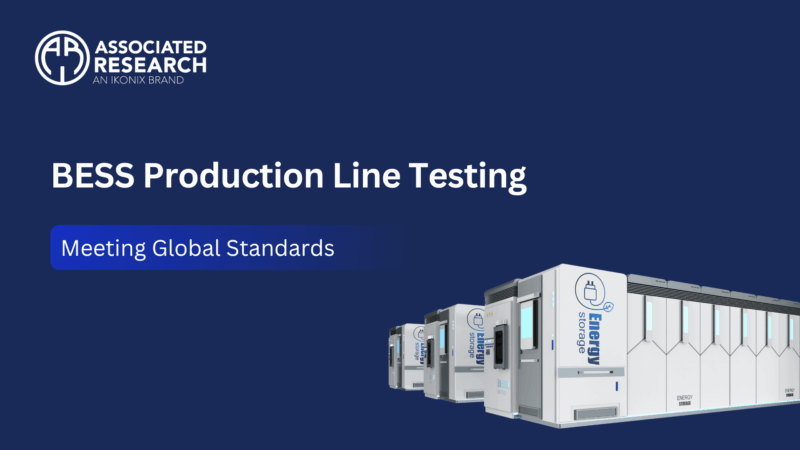
As the global adoption of renewable energy continues to accelerate, Battery Energy Storage Systems (BESS) have become essential infrastructure for maintaining grid stability, driving demand for rigorous BESS production line testing to ensure safety and performance at scale. By capturing excess power and releasing it during peak demand, these systems successfully balance intermittent energy sources like solar and wind power.
However, because of their massive energy capacities, battery systems carry unique operational risks. Battery failures can rapidly escalate into thermal runaway, leading to catastrophic fires or explosions. Consequently, meeting stringent international safety standards is a critical requirement for manufacturers, system integrators, and engineering teams.
To guarantee system integrity, manufacturers must implement 100% production-line testing, specifically focusing on Dielectric Voltage Withstand (Hipot) and Insulation Resistance (IR) tests. Utilizing strict BESS electrical safety testing protocols to verify insulation pathways and grounding reliability protects high-voltage systems (such as modern 1500 VDC utility applications) from critical failures.
Understanding Global BESS Testing Standards
When individual battery modules are integrated into a complete commercial or utility-scale Battery Energy Storage System, the entire ecosystem must comply with specific global standards:
- UL 9540: Focuses comprehensively on system-level safety, energy storage equipment, and environmental compliance.
- UL 1741: Directs safety requirements for power conversion equipment, including inverters, converters, controllers, and interconnection hardware (PCS).
- IEC 62933-5-2: Sets the international baseline for safety requirements for grid-integrated energy storage systems.
- GB/T 36276: Outlines specific performance and safety test protocols for lithium-ion batteries and modules destined for electrical energy storage applications.
Regulatory Comparison Matrix
| Standard | Hipot Voltage Range | Hipot Test Time | Hipot Pass Condition | Ground Bond Current | IR Voltage | IR Pass Condition |
|---|---|---|---|---|---|---|
| UL 9540 | 1000 – 3000 Vac / 1414 – 4242 Vdc | 60s | No Breakdown | 10A (0.1Ω max) | 500 Vdc | ≥ 1 MΩ |
| UL 1741 | 2V + 1000V | 60s | No Breakdown | 25A (0.1Ω max) | — | — |
| IEC 62933-5-2 | Un + 1200V | 5s | No Breakdown | — | 1000 Vdc | ≥ 1 MΩ |
| GB/T 36276 | 1080 – 3800 Vac / 1530 – 5370 Vdc | 60s | No Breakdown* | — | 500 – 2500 Vdc | > 1000 Ω/V |
*Note: For DC Dielectric Withstand Testing (DCW) under GB/T 36276, the leakage current must remain strictly below 10 mA.
Technical Deep Dives: Applying BESS Testing Standards
To properly execute these standards, production engineers must understand the distinct roles of each electrical safety test.
Dielectric Voltage Withstand (Hipot) Testing
The Hipot test applies an overvoltage stress to the battery system’s insulation barrier for a designated period (typically 60 seconds). This ensures that the insulation can handle unexpected voltage spikes during operation without breaking down.
AC vs. DC Hipot: While AC hipot stresses the insulation in both polarities, DC hipot testing is frequently preferred for large battery systems. This is because DC testing eliminates the continuous reactive charging currents caused by the high system capacitance inherent in large battery banks.
Insulation Resistance (IR) Testing
Unlike the Hipot test (which looks for catastrophic insulation breakdown or arcing), the IR test measures the exact electrical resistance of the insulation material. By applying a steady DC voltage (typically 500V or 1000V), it calculates the resistance value in Megohms (MΩ) or Gigohms (GΩ). This test is vital for detecting gradual insulation degradation over time caused by moisture, dust, or material aging.
Critical Challenges in BESS Production Line Testing
Integrating cells into modules, and modules into multi-layer Battery Cabinets managed by a Battery Management System (BMS), introduces severe testing bottlenecks. Manufacturers regularly confront three primary challenges:
1. Complex Multi-Point Testing Topologies
A complete battery cabinet requires multiple isolation checks: positive terminal-to-chassis, negative terminal-to-chassis, auxiliary power-to-ground, and cooling fan-to-ground pathways. Relying on manual cable switching between these test points drastically slows down cycle times, increases labor costs, and introduces significant human error.
2. High Risk of Backflow Equipment Damage
When testing large-capacity systems with multiple series-connected batteries, any wiring mistake or cell abnormality can cause a direct short circuit to the chassis. The immense energy stored in the battery system can flow back into the tester, destroying internal high-voltage components or creating explosive arc-flash hazards. Testers must feature hardware-level reverse-energy protection.
3. Escalating Insulation Voltage Demands
As commercial BESS architectures scale up to maximize efficiency, operational voltages are pushing past traditional limits. Many next-generation large-scale cabinets now require high-voltage insulation validation up to 20 kVDC to properly satisfy strict safety margins and quality control benchmarks.
Associated Research Advanced BESS Testing Solutions
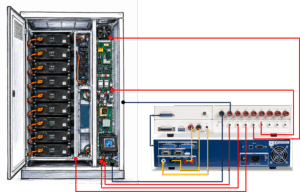
To solve these compounding production challenges, Associated Research offers a unified, automated testing ecosystem designed specifically for high-capacity battery manufacturing.
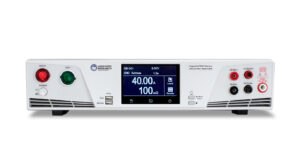
HypotULTRA 7854: 4-in-1 Electrical Safety Analyzer
The HypotULTRA 7854 integrates AC Dielectric Withstand (ACW), DC Dielectric Withstand (DCW), Insulation Resistance (IR), and Ground Bond (GB) testing into a single benchtop instrument. This removes the need for multiple independent instruments, cutting footprint requirements and reducing initial equipment expenditure.
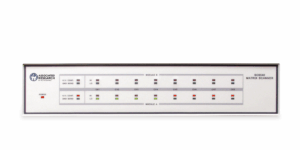
SC6540 Multiplexers: Automated Matrix Scanning
To eliminate manual cable changes, the SC6540 Multiplexer introduces automated multi-point scanning and channel switching. The system safely routes high voltage across the positive terminals, negative terminals, BMS lines, and chassis grounds in a pre-programmed sequence—maximizing throughput while removing operators from dangerous high-voltage contact.
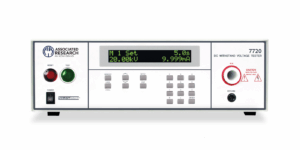
HypotMAX 7720: Ultra-High Voltage Verification
For systems demanding isolation verification well beyond standard limits, the HypotMAX 7720 delivers up to 20 kVDC of high-voltage output. This ensures full compliance for deep-insulation validation on high-capacity, next-generation utility battery enclosures.

WithStand Software: Data Traceability & Error Prevention
Operating as the central control hub, WithStand Software automates data logging to secure 100% production traceability. It supports direct barcode scanning to instantly recall the exact test profiles required for specific battery models, completely eliminating manual programming errors on the floor.
Summary of Solution Advantages
- One-Click Testing Execution: Complete an entire suite of regulatory safety tests with a single button press. The system sequences through tests seamlessly without requiring manual intervention, cable swapping, or line pauses.
- Industrial Safety & Control: Simplifies complex multi-point wiring layouts while leveraging hardware protections to insulate equipment from energy backflow and operators from high-voltage hazards.
Frequently Asked Questions
What is the main difference between system-level and component-level BESS standards?
System-level standards, like UL 9540 and IEC 62933-5-2, evaluate the complete integrated battery cabinet, thermal management, and safety systems working in unison. Component standards, such as GB/T 36276 and UL 1741, focus strictly on the individual assets within that system, such as the core lithium-ion cells or the power conversion inverters.
Why is energy backflow protection critical when testing battery storage systems?
Because battery packs store massive amounts of DC energy, a wiring mistake or internal short circuit during a hipot test can cause energy to discharge backwards into the test instrument. Without built-in backflow protection, this energy can destroy the tester’s high-voltage circuits and create severe safety hazards for the operator.
Can you use AC Hipot testing on a DC Battery Energy Storage System?
Yes, many standards allow either AC or DC hipot testing. However, because large battery cabinets have significant internal capacitance, an AC hipot test will generate extreme, continuous reactive charging currents that can trigger false failure trips. DC Hipot testing is generally preferred because it charges the system’s capacitance just once, allowing accurate leakage current measurements.

